Showing posts with label Inquiry Based Instruction. Show all posts
Showing posts with label Inquiry Based Instruction. Show all posts
Thursday, November 9, 2017
IBI - Lab Reflection
I think my first chance at an Inquiry Based Unit of instruction went okay, however (like after every lab), there several things that I would change about it.
First things first - I would connect it to Ag. While I was completing the lab, I realized I should have done a better job connecting the lab to Agriculture. My first thought about how to do this would be to include it in a bio-fuels unit in a biotechnology class. The pressure inside the balloon is comparable to the fuel. When the fuel is ignited (in this case the pressure is released) the balloon will be forced down the string according to Newton's laws. While it is as stretch, this could be a fun enrichment activity during a bio-fuels unit on a shorter day to build upon their knowledge and relate it to another industry.
This brings me to my second change - data. While my worksheet had a place for them for record observations and data, and then analyze and conclude, I think that it would be better to give them a specific set of data to record in this case instead of letting them decide. Or maybe give them choice? For example, they could measure how far their balloons go or how fast they go.
Finally, my last change would be to have them write procedures. Not only would they design their rockets but they would also write a procedure for how they are going to test it and collect their data. How are you going to design an experiment to test how far your rocket goes or how fast it gets there. When my tired brain was first trying to think of this lesson, I was thinking of them making "procedures" for building their rockets. The procedures that came with my experiment were:
1. Tie one end of a string to a chair, doorknob, or other support.
2. Put the other end of the string through a straw. Then pull the string tight, and tie it to another support in the room.
3. Blow up the balloon, and pinch the end of the balloon to keep the air inside. Do not tie the balloon.
4. Have a partner tape the balloon to the straw so that the opening of the balloon is horizontal with the ground, while you keep the air pinched inside the balloon.
5. Have your partner use the marker to draw a finish line near the end of the string. Then, let go of the balloon and observe!
I feel as though it would be better to give students these procedures of how to make a rocket. Then have them design procedures to test the distance or speed. After students have their hypothesis and procedure to test the data for a simple rocket they could then take it a step farther. They could re-design their rocket to try to get it to go farther or faster and test a new hypothesis.
To tie it all together the students could research which would go make a rocket go faster or farther - fossil fuels or bio-fuels (if we hadn't done it in class) and then assign each of their balloon designs to whether or not they were powered with fossil or bio-fuels.

Monday, October 30, 2017
IBI - the WHAT and the HOW
Inquiry Based Instruction - Curiosity meets the Scientific Method.
In this teaching method, students work on a problem to formulate questions, investigate their questions, observe and repeat until they can connect the information, make a conclusion and finally share their findings. What I find most impressive about this process is how fluid it can be. When we went on our field trip this morning to Greenwood, I would not have even known that I was observing IBI if I was not there specifically for that.
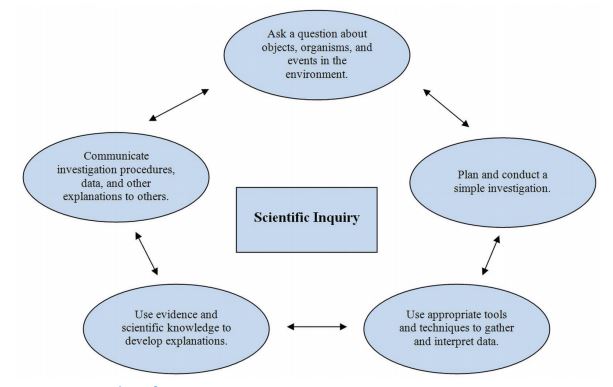
The five steps of IBI are:
1. Question
2. Investigate
3. Use evidence to describe, explain, and predict.
4. Connecting evidence to knowledge
5. Sharing findings.
The IBI method allows for students to have autonomy in their learning and gives teachers flexibility. It allows students to work together and learn from each other - showing and utilizing their strengths.While this method of teaching is commonly used in a scientific or laboratory setting, it can be used in many settings and classroom environments with a little creativity and a lot of plannning.
Although I would like to see some more examples of this type of instruction to become more knowledgeable about it, I feel as though triggering curiosity may be the most important, and difficult part. If students are not interested or curious it will make it much harder for them to formulate questions and research them to find answers/solutions. Furthermore, the more invested they are in the topic, the higher up Bloom's Taxonomy they will go - propelling them into the evaluating and creating stages.
I also believe that this type of learning would take a lot of time and planning for teachers that have never done it before. It would also be very important to make sure that you do not leave your students hanging. For example, while I think that helping students to work towards answers with questioning them and their thought process to lead them down the right path is important, I do not believe that this should ever be a "cop-out" for teachers to tell their students that they need to "figure it out". I feel like this could be a hole that educators could fall down into easily. I would like to remain mindful of this and make sure I am well prepared to help my students through the process with helpful questioning techniques to lead them down a path. The path may lead them back to the beginning, but will also help them to rule out solutions and ultimately help them find the right answer.

Subscribe to:
Posts (Atom)