Hi everyone! Here is me and Heather's Marketing Video! Take a sneak peak :)
Tuesday, November 28, 2017

Sunday, November 26, 2017
Weekley Investment #10 - Classroom Management
The last weekly investment of the semester is on classroom management!
My summer reading talked a lot about classroom management, rules, and expectations. If you missed in my previous blogs, this book was "What Great Teachers do Differently: 17 Things that Matter Most" by Todd Whitaker. Whitaker emphasizes that a teacher's classroom management sets the stage for student learning. He also says that great teachers focus on expectations while other teachers focus on the rules. The least effective teachers focus on the consequence of breaking the rules.
The best teachers, according to Whitaker, establish clear expectations at the start of the year and follow them consistently as the year progresses. For example, they may have three guidelines:
- Be repectful
- Be prepared
- Be on time.
These teachers expect good behavior and generally that's what they get. "Great teachers focus on the behavior they expect of their students, not on the consequences for misbehavior."
Some teachers focus on rules. While rules have their place and "school" and "rules" generally go together, they have their drawbacks. Rules mostly focus on undesirable behaviors. Stating what not to do, may actually lead to students doing just what you did not want them to do. Most people, especially our most challenging students, are typically contrary by nature. When someone says not to do something, you may not have even been thinking to do that thing until they said not to.
Consequences are yet another battle. "Rules outline the boundary between the acceptable and the unacceptable." Everyone is familiar with consequences. Take sports for example. Referees do not just point out the rule that was violated, they also assign a penalty. The purpose of consequences is to discourage people from breaking the rules. Whitaker points out that consequences frequently do just the opposite. He says that students are experts at cost-benefit analysis. "If I skip one hour of class, I'll have to go to two hours of detention. Is it worth it? How many of my buddies will be in detention?" Whitaker points out that the fear of the unknown can sometimes be a more powerful deterrent than a list of predetermined consequences.
I really enjoyed Todd Whitaker's book and his reasons for classroom expectations and consequences. In later chapters he also discusses meaning what you say. He reminds teacher that if they are saying the same thing over and over that they may be the problem. Remember to allow yourself time to think about inappropriate behavior before acting on it - and when you act on it, mean it.
Other reminders:
- You do not ever win an argument with a student.
- Treat students and parents with respect.
- Practice the "golden rule"
- Do not yell at students (unless in a true emergency.)
- Use your "bag of tricks"
- Remember the teacher is the variable.
"When a student misbehaves, great teachers have one goal: to keep that behavior from happening again."
My summer reading talked a lot about classroom management, rules, and expectations. If you missed in my previous blogs, this book was "What Great Teachers do Differently: 17 Things that Matter Most" by Todd Whitaker. Whitaker emphasizes that a teacher's classroom management sets the stage for student learning. He also says that great teachers focus on expectations while other teachers focus on the rules. The least effective teachers focus on the consequence of breaking the rules.
The best teachers, according to Whitaker, establish clear expectations at the start of the year and follow them consistently as the year progresses. For example, they may have three guidelines:
- Be repectful
- Be prepared
- Be on time.
These teachers expect good behavior and generally that's what they get. "Great teachers focus on the behavior they expect of their students, not on the consequences for misbehavior."
Some teachers focus on rules. While rules have their place and "school" and "rules" generally go together, they have their drawbacks. Rules mostly focus on undesirable behaviors. Stating what not to do, may actually lead to students doing just what you did not want them to do. Most people, especially our most challenging students, are typically contrary by nature. When someone says not to do something, you may not have even been thinking to do that thing until they said not to.
Consequences are yet another battle. "Rules outline the boundary between the acceptable and the unacceptable." Everyone is familiar with consequences. Take sports for example. Referees do not just point out the rule that was violated, they also assign a penalty. The purpose of consequences is to discourage people from breaking the rules. Whitaker points out that consequences frequently do just the opposite. He says that students are experts at cost-benefit analysis. "If I skip one hour of class, I'll have to go to two hours of detention. Is it worth it? How many of my buddies will be in detention?" Whitaker points out that the fear of the unknown can sometimes be a more powerful deterrent than a list of predetermined consequences.
I really enjoyed Todd Whitaker's book and his reasons for classroom expectations and consequences. In later chapters he also discusses meaning what you say. He reminds teacher that if they are saying the same thing over and over that they may be the problem. Remember to allow yourself time to think about inappropriate behavior before acting on it - and when you act on it, mean it.
Other reminders:
- You do not ever win an argument with a student.
- Treat students and parents with respect.
- Practice the "golden rule"
- Do not yell at students (unless in a true emergency.)
- Use your "bag of tricks"
- Remember the teacher is the variable.
"When a student misbehaves, great teachers have one goal: to keep that behavior from happening again."
Wednesday, November 22, 2017
Micro-Teaching Reflection Blog
Last week I was fortunate enough to teach 3 days of lessons at Bald Eagle High School. I taught lessons on soil nutrients and fertilizer. I thought my first day went really well with great feedback from Mr. Biddle. I used a power point and use of a couple activities - including a nutrient activity asking students where plants get their nutrients from and an activity to help students realize what pH different substances were. My lesson also included an interest approach and bellwork that asked students what they thought soil nutrients were and then the interest approach was a video that helped to define soil nutrients further.
Day 2 could have went a little better. It was a good lab about pH and soil pH, but would have been much better if it was split into 2 days with more summarizing activities. The first part of the activity was to help the students better understand pH in general, so they tested the pH of several different liquids with pH test strips. Second, I taught the students how to use the Cornell pH test it. I wish I would have spend more time on this and done a 3 step demonstration with the students - teacher says, teacher does; teacher says, student does; student says, student does. On my feedback forms, a couple of students commented that they had trouble getting the pH indicator separated out of the tray. More time for a proper demonstration would have solved this.
The third day was the review and the quiz. For the quiz I used some techniques we used in 412 for our quiz. After most of the students were complete with their quizzes, I allowed them to use their notes for two minutes. After the end of the two minutes, I gave them about one minute to finish their thoughts and then let them ask someone beside them one question. This seemed to go over well with the students and they did well on the quiz. While the review and quiz went well, I had about 3 or 4 minutes left at the end that I could have managed better.While they were taking their quiz we passed back some papers Mr. Biddle had for them. Many of the students were looking at these after they finished their quizzes and I lost control of the room and was not able to gain it back.
Please take a look at my video on Edthena or here!!
https://www.youtube.com/watch?v=r5RD0r5Ah2I
Thursday, November 9, 2017
IBI - Lab Reflection
I think my first chance at an Inquiry Based Unit of instruction went okay, however (like after every lab), there several things that I would change about it.
First things first - I would connect it to Ag. While I was completing the lab, I realized I should have done a better job connecting the lab to Agriculture. My first thought about how to do this would be to include it in a bio-fuels unit in a biotechnology class. The pressure inside the balloon is comparable to the fuel. When the fuel is ignited (in this case the pressure is released) the balloon will be forced down the string according to Newton's laws. While it is as stretch, this could be a fun enrichment activity during a bio-fuels unit on a shorter day to build upon their knowledge and relate it to another industry.
This brings me to my second change - data. While my worksheet had a place for them for record observations and data, and then analyze and conclude, I think that it would be better to give them a specific set of data to record in this case instead of letting them decide. Or maybe give them choice? For example, they could measure how far their balloons go or how fast they go.
Finally, my last change would be to have them write procedures. Not only would they design their rockets but they would also write a procedure for how they are going to test it and collect their data. How are you going to design an experiment to test how far your rocket goes or how fast it gets there. When my tired brain was first trying to think of this lesson, I was thinking of them making "procedures" for building their rockets. The procedures that came with my experiment were:
1. Tie one end of a string to a chair, doorknob, or other support.
2. Put the other end of the string through a straw. Then pull the string tight, and tie it to another support in the room.
3. Blow up the balloon, and pinch the end of the balloon to keep the air inside. Do not tie the balloon.
4. Have a partner tape the balloon to the straw so that the opening of the balloon is horizontal with the ground, while you keep the air pinched inside the balloon.
5. Have your partner use the marker to draw a finish line near the end of the string. Then, let go of the balloon and observe!
I feel as though it would be better to give students these procedures of how to make a rocket. Then have them design procedures to test the distance or speed. After students have their hypothesis and procedure to test the data for a simple rocket they could then take it a step farther. They could re-design their rocket to try to get it to go farther or faster and test a new hypothesis.
To tie it all together the students could research which would go make a rocket go faster or farther - fossil fuels or bio-fuels (if we hadn't done it in class) and then assign each of their balloon designs to whether or not they were powered with fossil or bio-fuels.
Monday, October 30, 2017
IBI - the WHAT and the HOW
Inquiry Based Instruction - Curiosity meets the Scientific Method.
In this teaching method, students work on a problem to formulate questions, investigate their questions, observe and repeat until they can connect the information, make a conclusion and finally share their findings. What I find most impressive about this process is how fluid it can be. When we went on our field trip this morning to Greenwood, I would not have even known that I was observing IBI if I was not there specifically for that.
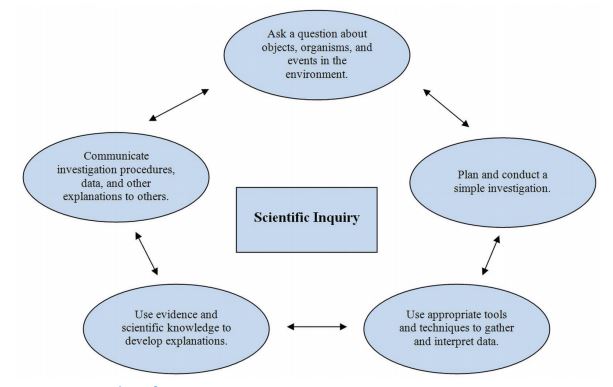
The five steps of IBI are:
1. Question
2. Investigate
3. Use evidence to describe, explain, and predict.
4. Connecting evidence to knowledge
5. Sharing findings.
The IBI method allows for students to have autonomy in their learning and gives teachers flexibility. It allows students to work together and learn from each other - showing and utilizing their strengths.While this method of teaching is commonly used in a scientific or laboratory setting, it can be used in many settings and classroom environments with a little creativity and a lot of plannning.
Although I would like to see some more examples of this type of instruction to become more knowledgeable about it, I feel as though triggering curiosity may be the most important, and difficult part. If students are not interested or curious it will make it much harder for them to formulate questions and research them to find answers/solutions. Furthermore, the more invested they are in the topic, the higher up Bloom's Taxonomy they will go - propelling them into the evaluating and creating stages.
I also believe that this type of learning would take a lot of time and planning for teachers that have never done it before. It would also be very important to make sure that you do not leave your students hanging. For example, while I think that helping students to work towards answers with questioning them and their thought process to lead them down the right path is important, I do not believe that this should ever be a "cop-out" for teachers to tell their students that they need to "figure it out". I feel like this could be a hole that educators could fall down into easily. I would like to remain mindful of this and make sure I am well prepared to help my students through the process with helpful questioning techniques to lead them down a path. The path may lead them back to the beginning, but will also help them to rule out solutions and ultimately help them find the right answer.

Friday, October 20, 2017
SURPRISE! Lab Reflection
So this week in lab we were given a set of AFNR standards on Monday and asked to write a lesson plan by Tuesday at 5PM for our lab on Wednesday. At first it was a little overwhelming, but once I came up with an idea, the lesson plan came together okay!
My standards were related to the food science industry trends, so I decided to do a lesson plan on GMO labeling. I based this lesson plan on being in a junior/senior food science class. I chose to split the class in to two groups and have them debate with one team being the affirmative and one team being the negative in respect in to food being labled with containing or not containing GMOs.
There were definitely some things I would change if I were to do this in an actual classroom. First, for the lab, I gave my peers a shortened amount of time than what I wrote my lesson plan for. I was trying to get the most out of the lab and the 43 minute lesson plan. In the future, I would assign groups and their side the night before. Not only would this allow for more time the next when the student were actually going to present, but it would also allow the students to prepare a little more.
I also notice that I REALLY need to work on giving directions clearly! I feel like I explain the assignment better after a student asks a question. Which is NOT what I want. I need to get better at more explicitly writing out the directions for myself, copying them onto the board, and then finally verbally expressing the directions of the assignment.
I think this overall assignment, although frustrating at first, was beneficial. It allowed me to see some more of my weaknesses. Also, even though I may not be teaching this exact lesson plan next semester, I could use the practices from it for another topic that I am teaching.
Sunday, October 15, 2017
Weekly Investment 8 - Differentiated Learning
This week in class
we learned about individualized learning and it was reinforced with this week's
readings. Individualized techniques we learned about are:
- Supervised Study
- Independent Study
- Experiments
- Notebooks
- Sheets
- Information
- Assignment
- Skill
This types of
learning strategies are to help students in an individual way and maybe not as
personalized.
What intrigued me
most about the reading though was learning about differentiated learning and
how it compares to individual learning. All throughout the semester we have
been learning about variability in the classroom. After learning more about
differentiated learning, I feel as though there are many similarities. While individualized learning begins with one
student's needs, differentiated learning starts with multiple students or
groups.
In most classrooms,
especially agriscience classrooms, you have students across the spectrum and
students that are reading and learning on different levels. For differentiated
learning, students are divided into groups for activities; however, students are
not always in the same group with the same people, and they do different types
of activities. Teachers must design their lessons around students' needs, which
creates a lot more work on their end. This is because each group is tasked with
completing an activity in a way that best suits them. This means not only is
the teacher taking the time to make sure special activities are planned, but
they are also taking the time to understand how their students learn and
separating them into groups based on that.
I don't foresee
myself using this type of learning all the time, but I can see myself figuring
out how to work this into my curriculum and using as part of my variability in
my classroom!
References:
(n.d.) Retrieved
October 15, 2017, from https://www.understood.org/en/school-learning/partnering-with-childs-school/instructional-strategies/individualized-instruction-vs-differentiated-instruction
EduGains.
(2015). Reach every student through
differentiated instruction. Retrieved from http://www.edugains.ca/resourcesDI/Brochures/DIBrochureOct08.pdf
Subscribe to:
Posts (Atom)